
Methods for Cutting Leather
Leather Cutting Methods — Essential Tools and Techniques for Precise Leathercraft
Cutting leather is the controlled separation of hide into parts that become finished products; the quality of each cut directly influences fit, edge finish, and long-term durability. Clean cuts depend on matching tool geometry, blade sharpness, and a stable support surface so fibers sever rather than tear or stretch. This practical guide explains which tools work best for specific leathers, step-by-step methods for straight and curved cuts, how skiving and pattern cutting affect assembly, and how die and laser systems scale production while preserving hand-stitched quality. We also address common production problems—misfit panels, excess waste, or burnishing failures—and offer actionable fixes and examples. Main sections include a tool comparison, material-specific methods with production notes, core cutting techniques and troubleshooting, die-cutting efficiencies with a manufacturer example, laser cutting trade-offs, and tool-care essentials like sharpening and workspace setup.
What Are the Best Tools for Cutting Leather?
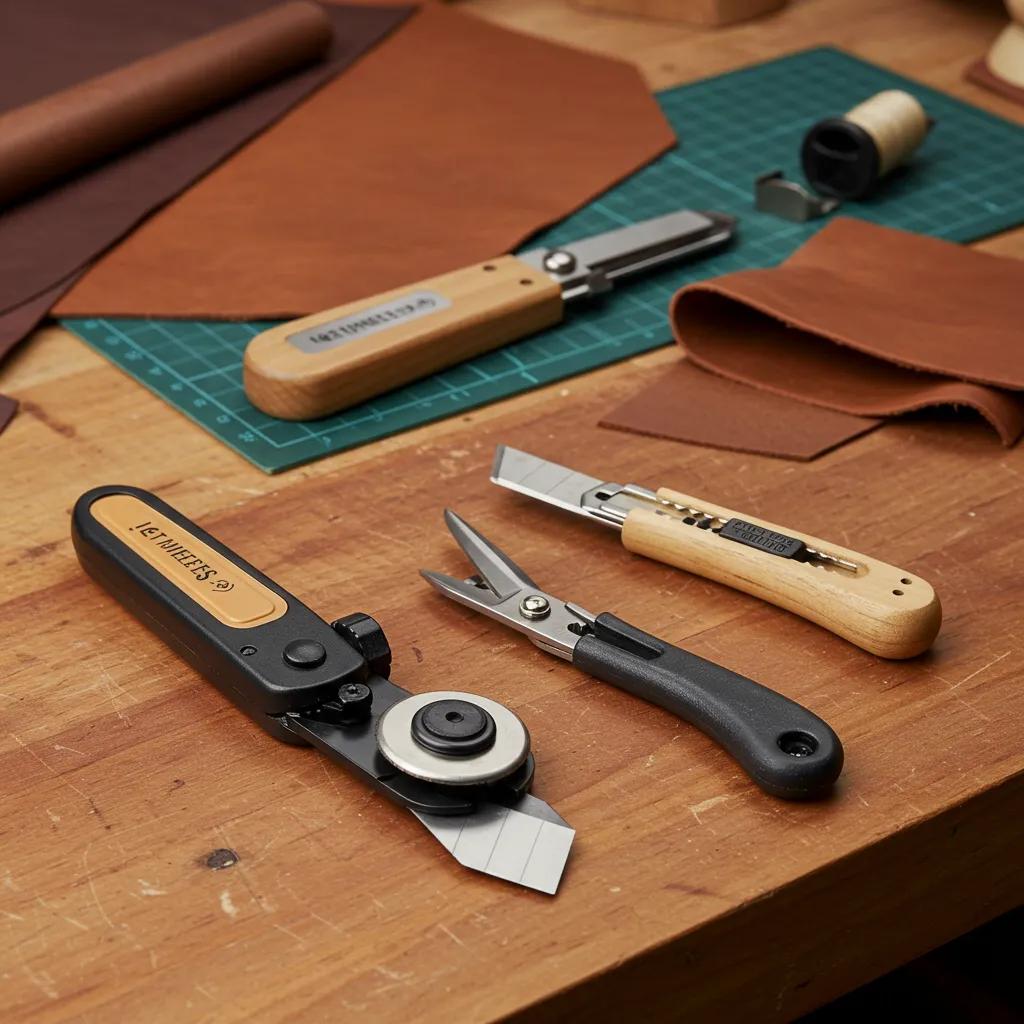
Tools for leather cutting span handheld craft knives to industrial die presses and lasers. Each tool concentrates force—mechanical shearing, rotary slicing, or focused thermal energy—to separate fibers cleanly. That mechanism dictates the best use: rotary cutters for long straight runs, shears for thickness and curves, knives for fine detail, dies for repeatability, and lasers for delicate perforations and engraving. Picking the right tool improves edge quality, cuts rework, and speeds assembly when paired with proper setup and blade care. Below is a short, ranked list to help quick decisions for workshops and small production runs.
The top tools for most leatherwork are:
- Rotary cutter: Ideal for long, straight cuts on thin to medium leathers and for fast pattern repeats.
- Leather shears: Best on thick hides and curved panels where blade leverage yields clean edges.
- Utility/craft knife: Best for precise trimming, notches, and fine skiving adjustments.
- Die cutting (clicker press): Best for consistent, high-volume pattern reproduction.
- Laser cutter: Best for intricate shapes, fine perforations, and surface etching on appropriate thin leathers.
These cover studio and small-factory needs; next we look closer at rotary cutters and why blade geometry matters for long, accurate cuts.
How Does a Rotary Cutter Improve Leather Cutting Precision?
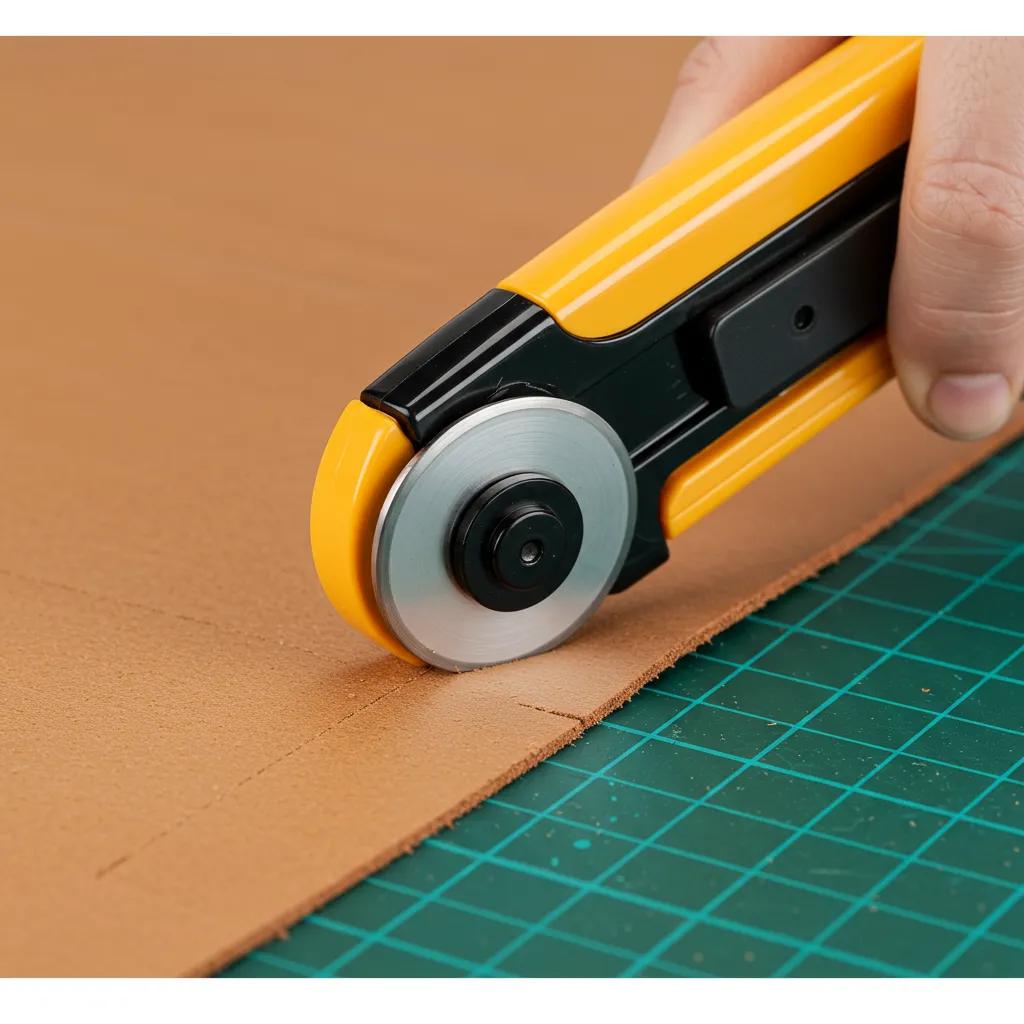
Rotary cutters increase precision with a circular blade that rolls over the leather, turning sliding friction into a continuous slicing motion that reduces drag and prevents wavy edges. They work especially well on thin to midweight leathers—lamb or midweight cow—because the rolling action maintains contact without stretching the hide. Blade size and sharpness matter: smaller wheels give tighter control on curves; larger wheels keep long straight cuts true. Replaceable blades make maintenance straightforward. Common mistakes are pressing too hard (which scallops the edge) or using dull blades (which tear fibers). Pair a rotary cutter with a metal straight edge and a stable cutting mat for best results before moving on to why heavy-duty shears are still essential for thick hides.
Why Are Leather Shears Ideal for Thick and Curved Cuts?
Leather shears use long, hardened blades and ergonomic leverage to shear dense fibers cleanly without crushing or crimping the edge—making them the go-to for heavy cowhide and buffalo panels. Shears can cut multiple layers when needed and hold edge quality on curves and corners where a rotary might chatter. Trade-offs are weight and cost: high-quality shears need professional sharpening and pivot maintenance. For jacket panels and shaped bag pieces, the leverage and blade length reduce fatigue and speed up work. When using shears, move the leather under the blades instead of forcing the blades through a static hide—a small technique that preserves edge quality and blade life.
Before the comparison table, here’s a compact EAV-style mapping to match tools with leather and cut types for quick reference.
Intro: The table below pairs common cutting tools with the leather types and cut styles where they perform best, so makers and production planners can choose quickly.
| Tool | Best For (Leather Type / Cut Type) | Key Advantage |
|---|---|---|
| Rotary cutter | Thin to medium leathers; long straight cuts | Rolling slice reduces drag and distortion |
| Leather shears | Thick cow/buffalo hides; curved panels | High leverage with clean shearing action |
| Utility/craft knife | Thin leather details and trimming | Fine control for precise edges |
| Die cutting (clicker press) | Repeated patterns across various thicknesses | Speed and dimensional consistency |
| Laser cutter | Thin, lightly finished leathers; detailed patterns | Microscopic accuracy for cuts and etching |
Use this quick map to reduce waste and improve fit; next we compare how leather species and thickness change tool choices.
How Do Different Leather Types Affect Cutting Methods?
Leathers—sheep, goat, cow, and buffalo—vary in thickness, grain, and tensile behavior, and those properties determine which cutting methods give clean results. Thin leathers like sheep and goat are supple with tight grain, so rolling or light slicing tools work best to avoid stretching. Thicker cow and buffalo hides have dense fiber bundles that respond better to shearing or mechanical cutting to prevent jagged edges. Prep steps—conditioning, flattening, and marking on the flesh side—stabilize hides before cutting, and grain direction affects edge behavior under tension. The table below summarizes recommended methods and production notes for common leather types to help estimate tooling and handling needs.
| Leather Type | Recommended Cutting Methods | Production Notes (thickness, grain, typical uses) |
|---|---|---|
| Sheep | Rotary cutter, craft knife, light skiving | Thin, supple, tight grain; suited to soft garments and small goods |
| Goat | Rotary cutter, swivel knife | Thin–medium, slightly firmer grain; great for wallets and small panels |
| Cow | Leather shears, round/utility knives, die cutting | Medium–thick, varied grain; common for jackets, belts, and bags |
| Buffalo | Heavy-duty shears, die cutting, clicker presses | Thick, dense fibers; used for heavy-wear goods and large panels |
These pairings clarify how material properties inform technique—next, thin-leather methods.
What Cutting Techniques Work Best for Thin Leather Like Sheep and Goat?
Minimize distortion with light pressure rotary cutting or a very sharp craft knife in short, controlled strokes. Support the leather on a firm cutting mat and use backing paper or tissue to prevent surface pull. Mark on the flesh side to avoid visible grain marks. Light skiving at seam lines removes bulk for neater folds or stitches. Regular blade changes and test cuts on scrap help you dial in settings before committing to production cuts.
How Should You Cut Thick Leather Such as Cow and Buffalo Hides?
For heavy cowhide or buffalo, use heavy-duty shears, round knives, or die cutting to apply enough shear force without compressing the edge and causing fraying. Secure large hides on a stable table and cut in staged sections to control grain direction and avoid wrinkles—production aids like clamps or vacuum tables are helpful. Select blades with strong bevels for heavy cuts and consider layered cutting under a clicker die to boost throughput while retaining dimensional tolerances. Proper staging lowers waste and prepares pieces for skiving and finishing.
What Are the Most Effective Leather Cutting Techniques?
Key techniques include straight-edge slicing with a metal guide, controlled curved cuts with swivel knives or small shears, pattern cutting with templates or dies, and skiving to thin edges at seams. Each technique depends on precise hand positioning and supportive tools for consistent results. Mechanisms are either focused shear (shears, round knife) or controlled slicing/ablation (rotary, laser). Understanding these helps troubleshoot wavy cuts or frayed edges. Below are practical steps and a short list of core techniques with their main benefits.
Common effective leather cutting techniques include:
- Straight-edge slicing: Use a metal straight edge with a rotary cutter or utility knife for long, accurate edges that match patterns.
- Curved cutting and swivel knives: Use small shears or a swivel knife for tight curves and detailed shapes to keep smooth radii.
- Pattern cutting and stacking: Employ dies or stacked layers for repeatable production parts to reduce variation.
- Skiving and thinning: Taper edges to remove bulk for cleaner seams and better stitchability.
These form the practical toolkit for individual craft and scaled production; next we outline step-by-step straight-cut technique.
How to Achieve Perfect Straight Cuts in Leather?
Start by marking the flesh side with a fine, non-marring marker, set a metal straight edge as your guide, and cut away from your body in steady, continuous strokes. Use a sharp rotary cutter or straight blade; replace or rotate blades when you feel drag or see tearing. Use multiple light passes instead of a single heavy cut to avoid waves. Clamp the guide where possible and tension the leather only enough to remove slack without distorting the grain—this preserves pattern alignment across panels.
What Are the Best Practices for Curved and Intricate Leather Cuts?
For curves and fine detail, pick small, sharp shears or a swivel/round knife for best control. Lightly score the outline before the full cut to set a clean path. Turn the leather under the blade rather than forcing the blade around the curve—moving the workpiece preserves blade geometry and reduces wear. Use carbon paper or waxed templates for repeatable transfers, and add relief cuts on internal curves to avoid tension and tearing. These steps reduce rework and keep parts ready for assembly.
How Does Die Cutting Enhance Leather Manufacturing Efficiency?
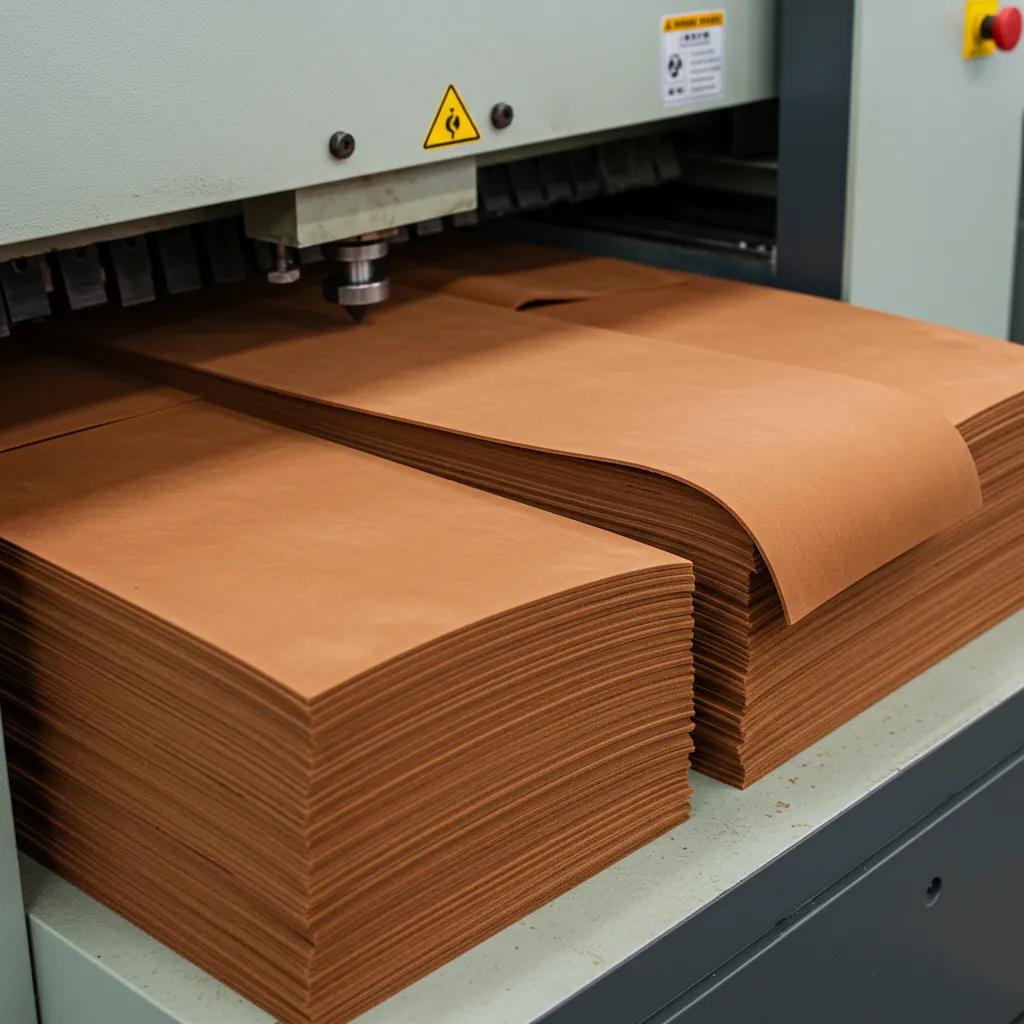
Die cutting uses hardened steel or machined dies in a press to cut leather quickly and uniformly. A single high-force stroke shears multiple layers or produces exact outlines repeatedly. Benefits include dimensional repeatability, lower per-piece labor, and consistent edge geometry that improves stitch alignment and assembly speed. Smart die nesting and pattern layout reduce scrap and help manufacturers meet export tolerances at scale. Below is a concise table mapping die types to use cases and production gains to guide die strategy decisions.
Intro: The table below lists common die types used in leather production and the operational benefits they deliver for different product classes.
| Die Type | Use Case | Production Benefit (speed, consistency, waste reduction) |
|---|---|---|
| Clicker die | Single-layer hand-fed or semi-automated presses | Good for medium volumes and fast die changes |
| Hard-rule die | Thick, reinforced dies for heavy hides | Durable with precise edges for heavy materials |
| Laser template + CNC-cut die | Prototyping and low-volume custom shapes | Fast turnaround and accurate nesting for low waste |
This die overview explains when dies boost throughput; next we cover the concrete advantages for custom shapes and production quality.
What Are the Advantages of Using Die Cutting for Custom Leather Shapes?
Die cutting delivers precise repeatability, so panels match pattern tolerances and stitched assemblies align predictably—reducing fit rework and improving final appearance. Speed matters: presses can cut dozens to hundreds of identical pieces per hour depending on die type, lowering labor per piece and shortening lead times for export orders. Less human variation reduces quality overhead because pieces arrive within stitch-ready tolerances. Those production benefits support high-quality leather product workflows and QA checkpoints.
How Does Die Cutting Support High-Quality Leather Product Production?
Die-cut accuracy improves assembly by producing consistent edges that match for stitch placement and cut down on bulk differences that can compromise seam strength or aesthetics. Standardized parts simplify artisan finishing—when panels are consistent, craftsmen focus on stitch and edge finishing rather than corrective trimming. Efficient nesting lowers waste per hide and helps control material costs for high-end custom or wholesale orders. Those efficiencies lead into laser cutting, which suits different design goals and trade-offs.
For production partners and wholesale buyers seeking hand-stitched quality combined with production-grade cutting, Pakistan Leather is a manufacturer and exporter focused on premium leather jackets and bags. Their workflows blend professional rotary cutters, heavy-duty shears, and die equipment to guarantee precise paneling and consistent stitch alignment. Customers can request Pantone-matched colors, which are planned into cutting and nesting to minimize waste while keeping color consistency on larger orders.
To discuss custom orders, wholesale pricing, or how cutting choices affect fit and export readiness, Pakistan Leather accepts enquiries for bespoke manufacturing and can recommend tooling and production options for your specs. Their mix of hand-stitched finishing and mechanized cutting supports small custom runs and larger export volumes while protecting edge quality and assembly tolerances required by premium goods.
Laser cutting’s repeatability and precision make it attractive for intricate patterns and detailed decorative work on select leather types.
Laser Cutting for Leather: Consistency and Effectiveness
Laser cutting has become more common in leather applications because it delivers consistent, high-precision results for complex geometries used in footwear, apparel, and accessories. In one study, the diode laser was favoured for leather cutting due to controllable power density, compact size, and portability, while CO2 lasers were reported as harder to control. Diode systems can address some CO2 limitations—such as power use, carbonization, and geometric inaccuracy—when set up correctly.
Carbonization region measurement in vegetable tanned goat leather using machine vision system for evaluating performance measures of leather cut contour edges, S Vasanth, 2022
What Are the Benefits and Uses of Laser Cutting in Leatherwork?
Laser cutting uses a focused beam to vaporize a narrow kerf through leather, giving exceptional precision for intricate patterns, perforations, and fine etching that mechanical tools struggle to match. Because lasers don’t touch the material, delicate shapes hold their geometry without mechanical distortion—but the thermal interaction can darken edges, harden the cut zone slightly, and create smoke or residue that needs ventilation and cleaning. Lasers are excellent for decorative panels, logo etching, and precise perforations for breathability or ornamentation, but they require material testing and careful settings for coatings and thickness. The next table outlines which leathers typically suit laser processing and key considerations for production and post-cut treatment.
Intro: This table compares laser suitability across leather types and summarizes practical considerations and post-cut steps.
| Leather Type | Laser Suitability | Key Considerations |
|---|---|---|
| Thin vegetable-tanned | High | Clean cuts and etching; minimal burn if parameters are right |
| Corrected grain (light finish) | Moderate | Test coatings to avoid toxic fumes and edge issues |
| Oily or heavily finished | Low | Risk of flare, poor edge finish, and strong odours |
| Thick hides | Low | Limited penetration; mechanical cutting usually preferred |
This comparison helps designers and manufacturers decide when laser cutting adds value and when to stick to mechanical methods.
How Does Laser Cutting Enable Intricate Leather Designs?
Laser cutting turns a computer path into a precise thermal cut with very high repeatability, enabling filigree, tiny perforations, and micro-engraved logos that are difficult by hand. With no mechanical force, fragile shapes don’t stretch and remain true—useful for decorative panels and layered assemblies. Downsides include extraction and fume control, possible edge darkening, and the need to test coatings or adhesives that may off-gas. Run trials on scrap and adjust power and speed before production to ensure clean results.
What Types of Leather Are Best Suited for Laser Cutting?
Thin, lightly finished, or vegetable-tanned leathers are best for laser work because the beam passes cleanly with minimal charring. Avoid oily, heavily pigmented, or very thick hides unless the laser is specifically rated and tested for those materials—uneven absorption can produce poor edges or hazardous fumes. Always perform controlled test cuts to set power and speed, inspect edges for discoloration or residue, use proper ventilation, and consider light buffing or dye touch-up as post-cut finishing.
How Can You Maintain and Care for Leather Cutting Tools?
Tool care includes regular sharpening and stropping, pivot lubrication and tension checks for shears, scheduled blade replacement for rotary cutters, and maintaining smooth work surfaces to protect edges and dimensional accuracy. A routine prevents dulling defects like torn edges or excessive operator force and avoids costly mid-production failures. Below is a short maintenance checklist followed by sharpening tips for common blades.
The essential maintenance checklist includes:
- Daily stropping: Run a leather or canvas strop before each session to realign edge burrs.
- Periodic stone sharpening: Use fine whetstones for utility knives and round blades every few weeks, adjusted for usage.
- Shear hinge care: Clean, realign, and lubricate pivots; set tension for smooth cutting without rubbing.
- Cutting mat rotation: Rotate or replace mats to avoid uneven surfaces that prematurely dull blades.
These steps reduce dulling and poor cuts; below are targeted sharpening methods for different blade types.
What Are the Best Methods for Sharpening Leather Cutting Blades?
For knives and shears, combine stropping with periodic whetstone work: use a fine-grit stone at the correct bevel to remove nicks, then finish on a leather strop to polish the edge and remove burrs. Shears may need professional realignment and honing when wear is uneven—keep the pivot screw tensioned to prevent blade rubbing and frayed cuts. In small shops, rotary blades are usually replaced rather than resharpened—keep spares and swap them at the first sign of drag to avoid tearing. Always wear cut-resistant gloves when changing blades.
Why Are Cutting Mats and Work Surfaces Essential for Leather Cutting?
Good cutting mats and a stable work surface protect blade edges, give a flat plane for consistent cuts, and often provide measurement guides or non-slip textures that aid precision and safety. A worn or uneven mat can make the blade catch, producing waves or nicks; a flat, well-supported table reduces fatigue and improves repeatability with large hides. Use metal straight edges and clamps or weights to secure leather during long cuts; keep the workspace clean so debris won’t interfere with die placement or blade travel. Proper surfaces complete the chain from sharp tools to finished assembly quality.
For production partners and wholesale buyers who want hand-stitched quality combined with production-grade cutting, Pakistan Leather manufactures and exports premium leather jackets and bags. Their workflow pairs professional rotary cutters, heavy shears, and die equipment to deliver precise panels and reliable stitch alignment. Customers can request Pantone-matched colours; this is built into cut planning and nesting to reduce waste and preserve colour accuracy on large orders.
To enquire about custom orders, wholesale pricing, or how cutting choices affect product fit and export readiness, contact Pakistan Leather for bespoke manufacturing options and tooling recommendations tailored to your specifications. Their mix of machine-cut efficiency and hand-stitched finishing supports both small custom runs and larger export volumes while maintaining edge quality and assembly tolerances expected in premium goods.
Frequently Asked Questions
What safety precautions should I take when cutting leather?
Always prioritise safety. Use sharp tools—dull blades are more likely to slip—and wear cut-resistant gloves for hand protection. Keep your work area well lit and organised, use a stable cutting mat, and cut away from your body. Keep fingers clear of the blade path and store blades safely when not in use.
How can I reduce waste when cutting leather?
Plan layouts carefully and use nesting techniques to place patterns tightly on the hide. Use die cutting for repetitive shapes to optimise layout, and retain offcuts for smaller components or trims. Regularly review your cutting methods and tooling to identify and eliminate sources of scrap.
What is the difference between skiving and thinning in leather cutting?
Skiving removes edge material to create a tapered profile—useful at seams and folds—while thinning reduces the overall thickness of a piece to make it more pliable or stitch-friendly. Both require precision to preserve strength and appearance.
Can I use regular scissors for cutting leather?
Regular scissors can work on very thin leather but aren’t ideal for clean, precise cuts on thicker hides. Leather shears are engineered for density and leverage; they give cleaner edges and less operator strain. Invest in proper tools for quality results.
How do I choose the right cutting tool for my leather project?
Base the choice on leather type, thickness, and cut complexity. Use a rotary cutter for straight cuts on thin to medium leather, shears for thick hides and curves, and a utility knife or laser for intricate designs. Match tool, technique, and prep to the material for best results.
What maintenance is required for leather cutting tools?
Keep blades sharp with daily stropping and scheduled stone sharpening. Clean and lubricate shear pivots, replace rotary blades at the first sign of drag, and rotate or replace cutting mats to maintain a flat, even surface. A regular maintenance routine prevents defects and downtime.
Conclusion
Precision in leather cutting starts with the right tools, the right technique, and consistent tool care. Understand how leather type influences method, practice the core cutting techniques, and adopt sensible maintenance to reduce waste and improve finish. If you’re ready to raise your leatherwork, explore our recommended tools and contact Pakistan Leather for production and bespoke manufacturing support. Start refining your cuts today.


