
How to Match Leather Colors

How to Match Leather Colors: The Ultimate Leather Color-Matching Guide with Custom Pantone Solutions
Leather color matching is the practical process of turning a color specification—most commonly a Pantone reference—into a repeatable leather finish that honors design intent, meets production tolerances, and satisfies end users. Good color matching requires a working knowledge of color theory (hue, value, chroma), how different leather types take dye, and the quality controls that keep results consistent from lab dip to bulk run. This guide explains why precise color matching matters for style and brand identity, how the Pantone TCX system is used in practice, a step‑by‑step workflow for custom color development, and options for restoring or recoloring faded leather. You’ll find clear instructions for submitting samples, reading color charts and Pantone codes, and assessing results with colorimeters and fastness testing. We also map who benefits most from custom leather color matching—from bespoke buyers to wholesale and export clients—and show how manufacturers convert a Pantone swatch into production at scale.
What Is Leather Color Matching and Why Is It Important?
Leather color matching aligns a target color with the pigments and finishes applied to leather so multiple pieces read as the same color under normal viewing conditions. The process converts color data (a Pantone TCX or a physical swatch) into a dye or pigment formula, trials it on the specified leather type, and adjusts for finish and lighting. The main benefit is consistent visual identity across product lines, replacement parts, and bespoke pieces—preserving brand integrity and cutting returns. Accurate matching also makes scaling production feasible when identical tones must be reproduced across many hides and lots.
How Does Leather Color Affect Style and Brand Identity?
Color sets mood, signals perceived quality, and positions a brand—rich cognac reads heritage, while saturated reds and blues point to trend-focus. A leather’s color affects perceived value and must work with hardware, stitching, and linings to tell a cohesive product story. For designers, choosing leather color is a strategic decision that impacts marketing, seasonal collections, and customer recognition across categories like jackets, bags, and accessories. Thinking about color relationships and audience early in the design phase reduces revisions during development.
What Are the Common Challenges in Matching Leather Shades?
Matching leather is technically demanding because hides differ, finishes change appearance, and lighting shifts perception—issues often grouped under metamerism. Natural hide variation alters dye uptake, so the same recipe can look different on separate panels; finishes and topcoats affect gloss and depth; and digital visuals rarely match physical swatches. Professionals manage these problems with lab dip rounds, physical swatches for approval, and objective tools like colorimeters and fastness testing. Those measures pair with color theory to predict and correct for variability.
- Typical mismatch sources: hide variation, uneven dye uptake, and finish effects.
- Lighting and metamerism can make two samples appear different under daylight versus artificial light.
- Digital-to-physical errors happen when RGB or hex values are used without a Pantone TCX reference.
These challenges call for a workflow that prioritizes physical swatches and iterative testing until samples fall within an acceptable tolerance. The next section explains the color theory that guides those adjustments and why hue, value, and chroma matter for leather dyeing.
How Does Leather Color Theory Help in Matching Leather Shades?

Leather color theory applies hue, value, and chroma to predict how dyes and pigments will behave on organic substrates, guiding pigment selection and layer strategies. In practice: hue locates the color on the wheel, value controls lightness, and chroma sets saturation—together they determine which pigments and base dyes are most likely to match a given leather type. The practical benefit for manufacturers and designers is a repeatable approach to building formulas that account for substrate absorption, finishing layers, and contrasts with linings or hardware. Knowing these relationships shortens trial rounds and improves first‑pass lab dip success.
What Are Primary, Secondary, and Tertiary Colors in Leather?
Primary, secondary, and tertiary color theory works the same in leather as in other media, though leather adds practical limits because of available pigments and dye chemistry. Primaries (reds, blues, yellows) are mixing foundations; secondaries come from combining primaries and show how to neutralize or warm a tone; tertiaries describe the intermediate hues used to achieve subtle vintage or earthy shades popular in leather goods. Because dyes interact with tannins and grain, teams choose between pigment layering (pigmented finishes) and dye blends (aniline processes) based on desired translucency and depth. Those constraints determine whether a shade is best achieved via dye formulation, pigmented topcoats, or a hybrid technique.
How Do Complementary and Analogous Colors Influence Leather Matching?
Complementary and analogous relationships guide coordinated sets and accent choices: complementary colors create contrast, while analogous tones build harmony across product families. From a production standpoint, complementary accents can tolerate slightly looser tolerances because contrast conceals small differences; analogous schemes require tighter control to keep pieces cohesive. Designers often select hardware and lining colors using these relationships to preserve perceived balance. These pairing rules feed directly into Pantone-driven workflows when translating designer references into reproducible leather swatches.
How Does the Pantone System Ensure Accurate Leather Color Matching?
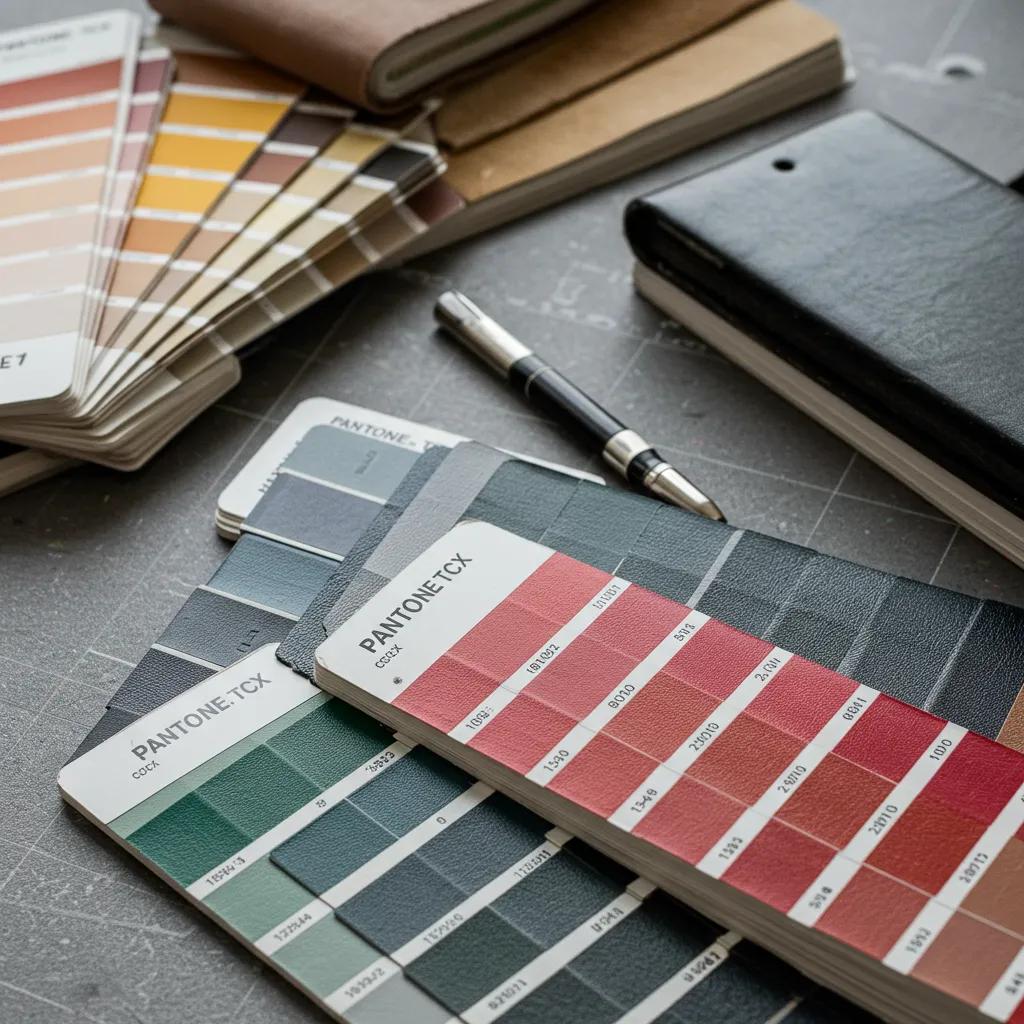
Pantone is a shared color language: a Pantone TCX code is a textile-ready reference that anchors expectations between designers and manufacturers and removes ambiguity from color briefs. The mechanism is the physical TCX swatch plus its code; manufacturers translate that target into dye recipes and lab dips while accounting for substrate differences. The benefit is a verifiable benchmark for approvals and QC—vital for bulk orders and export clients who need documented color conformity. Digital files alone aren’t enough; physical TCX swatches and lab dip approvals remain the backbone of dependable color matching.
Recent advances in digital color management help standardize color communication across platforms and industries. These systems reduce gaps between physical samples and screens, supporting greater consistency from design through production.
Pantone Matching System in Digital Color Environments
Currently, a number of products are seen as solutions in the realm of color usage in the computing environment. Four different contributions, PostScript Level 2 (Adobe), PhotoYCC (Eastman Kodak), Pantone Matching System (Pantone), and TekHVC (Tektronix), each deliver a component of electronic
What Is the Pantone TCX System and How Is It Used for Leather?
Pantone TCX (Textile Cotton eXtended) supplies physical color chips produced on textile substrates; designers use TCX swatches to communicate exact shades that textile and leather makers can interpret. Converting TCX to leather requires recognizing that cotton and leather differ in absorbency and reflectance, so formulas are adjusted with pigments, dyes, and topcoats to match perceived color under standard light sources. Best practice is to send a physical TCX swatch and specify the target finish (matte, semi‑aniline, pigmented) so the conversion can account for gloss and depth. This workflow leads directly into manufacturer conversion methods and the QC steps used to translate TCX references into leather.
Before the conversion table below: this table maps common Pantone TCX codes to leather types and expected adjustments. It’s a practical tool to help designers estimate whether a tone will need warming, cooling, or extra pigment undercoating—so teams can budget lab dips and QC checks appropriately.
| Pantone TCX | Leather Type | Notes on Expected Result |
|---|---|---|
| 18-1142 TCX | Goat leather | Slightly warmer; requires pigment adjustment and a matte topcoat for depth |
| 14-1116 TCX | Sheep leather | High dye uptake; reduce chroma to avoid oversaturation |
| 19-4028 TCX | Cow leather | Strong absorption; may need a neutral undercoat for deep navy |
| 16-1526 TCX | Buffalo leather | Coarser grain; increase pigment to stabilize hue across hides |
How Does Pakistan Leather Use Pantone for Custom Color Development?
Pakistan Leather (also trading as Atlanta Enterprises) converts Pantone TCX references into production‑ready leather through a structured workflow: sample conversion, lab dips, client approvals, and fastness testing across sheep, goat, cow, and buffalo leathers. The process starts with a physical Pantone reference or TCX code, proceeds through formulation trials on the specified leather, and includes review rounds and performance testing before scaling to production. Because Pakistan Leather handles custom manufacturing and precise Pantone matches, customers get a single partner able to move from prototype to bulk while keeping color consistency and documented QC. That capability supports bespoke requests and wholesale/export orders where traceable Pantone‑to‑leather conversion is essential.
What Is the Step-by-Step Process for Custom Leather Color Development?
Custom color development follows clear stages from initial spec to production QA, each with deliverables and client responsibilities that speed approvals. The workflow is an iterative loop: specification → lab dip → physical swatch → client feedback → revision → production trial → scaled production with QC. The main benefit is a controlled path that delivers reproducible color consistency across lots and leather types, reducing rework and returns. Below is a concise How‑To of a typical custom color development workflow.
- Specification & Brief: Client provides a Pantone TCX or physical sample, leather type, and finish specifics.
- Formulation & Lab Dip: Lab develops an initial dye/pigment recipe and applies it at small scale for review.
- Physical Swatch & Review: A full‑size swatch is produced and measured; client reviews it under standard lighting.
- Revisions & Final Approval: Agreed lab dip rounds are completed; once approved, a production trial run follows.
- Production Scale & QC: Bulk production begins with colorimeter checks, fastness tests, and batch documentation.
These stages form a repeatable template that clarifies timelines and responsibilities for both client and manufacturer. The next table outlines typical deliverables and time expectations to help buyers plan projects.
| Stage | Deliverable | Typical Time / Client Input |
|---|---|---|
| Specification | Pantone TCX code or physical sample | 1–3 days / provide sample and finish details |
| Lab Dip | Small‑scale test swatch | 3–7 days / feedback required |
| Physical Swatch | Full leather swatch with finish | 7–14 days / approve or request revision |
| Production Trial | Bulk trial batch | 7–21 days / QC sign‑off |
| Full Production | Completed order with QC report | Varies / final approval and scheduling |
How Do You Submit Samples for Custom Leather Color Matching?
Good samples start with a Pantone TCX or a high‑quality physical swatch, a clear leather type, the desired finish, and any performance requirements (color fastness, abrasion resistance). Pack samples so they won’t scuff, and label each with the Pantone code, item purpose, and contact details so labs can match samples to briefs without delay. A palm‑sized hide piece is the recommended minimum for accurate finish application; photos shot under standardized lighting can support the physical reference. Clear sample submission reduces back‑and‑forth and speeds lab dip and approval stages.
- Include: Pantone TCX or physical swatch; leather type (sheep, goat, cow, buffalo); finish specification.
- Label: Pantone code, sample ID, and product notes to avoid confusion.
- Ship: Protect samples from moisture, folding, and abrasion to preserve the reference.
Complete sample submissions allow the lab to begin formulation immediately and prevent delays caused by missing information. The following subsection outlines key deliverables during formulation through approval.
What Are the Key Stages from Color Formulation to Final Approval?
The key stages mirror the numbered workflow and emphasize specific deliverables: a lab dip recipe, a finished physical swatch, a production trial batch, and QC documentation including colorimeter readings and fastness test results. Each lab dip round typically includes small adjustments to chroma, hue, or value and a short report explaining the change and rationale; clients then approve or request further work. Production approval requires visual acceptance plus technical checks for rub, lightfastness, and surface uniformity to ensure the color performs in use. Clear timelines and revision limits—set at project start—help both manufacturers and buyers move efficiently to production.
Color fastness is a core quality metric, especially in fashion where durability and appearance matter. Modern evaluations increasingly pair expert review with digital tools to boost accuracy and speed.
Digital Transformation in Leather Color Fastness Evaluation
Leather is a critical material in the fashion industry, where it must meet customer demands for color, specification, and performance—particularly color fastness. Traditional assessments rely on trained evaluators using grey scale standards, but human appraisal can vary with lighting and perception. In this study, leather samples were evaluated by experts with grey scale scoring and compared with spectrophotometer measurements processed by custom Python software. The software produced precise grey scale values from the instrument data, enabling quicker, more consistent digital assessments. Results showed the computer‑assisted method reduced time and error margins, offering a reliable, efficient alternative to manual evaluation and streamlining leather testing workflows.
How Can You Restore and Match Faded or Discolored Leather Colors?
Restoring faded leather means choosing between surface recoloring, spot dyeing, full re‑dyeing, or panel replacement—depending on wear extent, substrate, and durability needs. Surface recoloring uses topical repair paints to blend small areas; spot dyeing targets localized discoloration; full re‑dyeing renews tone across the whole piece but requires finish rework. Professional restoration improves visual match and extends life, though exact factory original may not always be possible because of aging and wear. The right technique depends on leather type, past treatments, and expected longevity.
Each restoration method balances accuracy, durability, and cost. The table below helps by matching technique to suitability and likely outcomes.
| Technique | Suitability | Expected Outcome |
|---|---|---|
| Surface Recoloring | Small scuffs, surface fading | Good visual match for minor issues; limited durability |
| Spot Dyeing | Localized stains or discoloration | Precise correction with moderate durability |
| Full Re-dyeing | Uniform fading over large areas | High match accuracy; requires finish rework |
| Replacement Panels | Severe damage or structural wear | Best for a near‑perfect match but higher cost |
What Techniques Are Used to Restore Faded Leather Colors?
Common techniques include surface recoloring with repair paints, spot dyeing with matched pigments, complete re‑dye processes that penetrate the leather, and selective panel replacement for badly worn sections. Surface recoloring is quick and cost‑effective for light damage but less durable than re‑dyeing; spot dyeing balances precision and longevity for focal fixes. Full re‑dyeing restores uniform tone and is typically paired with conditioning and protective topcoats to improve fastness. For high‑value goods, manufacturer‑level custom dyeing delivers better pigment control and finish consistency than consumer kits.
How Does Custom Dyeing Help in Leather Color Restoration?
Custom dyeing at production scale uses controlled pigment blends, standardized application, and consistent finish systems to more accurately match original tones and produce durable results that withstand wear and environment. The process reformulates dyes to compensate for age‑related shifts and validates outcomes with colorimeter readings and fastness testing. Compared with ad‑hoc repairs, custom dyeing yields greater consistency and color stability—important when replacing parts on established product lines. For designers and brands that require exact replacements, manufacturer dyeing provides documented, repeatable processes.
Who Can Benefit from Custom Leather Color Matching Services?
Custom color matching helps a broad range of buyers—from individuals seeking bespoke pieces to wholesale and export clients who need documented color consistency across large orders. Services are tailored: single‑item or small‑batch dyeing for individuals; documented lab dip and QC procedures for wholesale; and export‑ready packaging and specification control for overseas buyers. The business goals are clear: deliver direct sales to individuals, secure bulk orders, build trust, and showcase manufacturing capabilities and product quality. Mapping benefits to buyer needs makes next steps—requesting samples or quotes—easier to plan.
How Do Wholesale and Export Clients Use Custom Color Solutions?
Wholesale and export clients focus on batch consistency, predictable lead times, and the documentation required for import/export checks. Their workflows fold sample approval, production trials, and QC sign‑offs into procurement schedules. Because consistent color across many hides is essential, manufacturers use colorimeter checks and maintain master recipes for repeat orders. Export customers also need clear packaging and labeling tied to approved swatches to prevent discrepancies on arrival. A checklist—sample approval, trial run, QC report, and master recipe—keeps large orders aligned to specs.
What Options Are Available for Individual Customers Seeking Bespoke Leather Colors?
Individuals can order bespoke services for single items or small runs by providing a Pantone TCX reference or a quality photo and selecting leather type and finish to match vision and budget. Typical choices include one‑off dyeing for a repaired jacket, small batches of custom bags, or made‑to‑order accessories where exact tone matters. Turnaround for bespoke work is often faster than bulk projects, but precise matching still follows lab dip and swatch approval steps to ensure satisfaction. Clear communication and willingness to review physical swatches help individuals get reliable results.
- Individual bespoke services: single‑item re‑dyeing, small‑batch custom production, and tailored finish choices.
- Wholesale/export services: master recipes, production trials, and QA processes for repeatability.
- Designers and brand teams: a mix of bespoke runs and larger production for seasonal collections.
Whether you’re an individual ordering one piece or a buyer coordinating large export orders, a structured color development workflow ensures consistent, high‑quality results. The final section below normally guides next steps for contacting manufacturers and requesting quotes.
Frequently Asked Questions
What Factors Influence the Cost of Custom Leather Color Matching?
Cost depends on color complexity, leather type, and order scale. Small bespoke jobs often have higher per‑unit costs because matching is labor‑intensive and requires precise formulations. Larger orders benefit from economies of scale and lower per‑unit cost. Added QC, documentation for export, or special fastness testing will also affect price.
How Long Does the Leather Color Matching Process Typically Take?
Timelines vary by project. Initial specifications and lab dips can take 1–3 days; full physical swatch approvals typically add 7–14 days. Revisions extend the schedule, and production trials plus QC for bulk orders may add 7–21 days. Prompt feedback and clear briefs help shorten overall lead time.
Can Leather Color Matching Be Done for Vintage or Antique Leather?
Yes—though vintage or antique leather presents unique challenges because aging alters color and texture. Restoration often begins with a careful assessment and may use surface recoloring, spot dyeing, or full re‑dyeing. Professional restorers commonly use custom dye formulations to replicate the original hue while respecting the leather’s current condition and wear patterns.
What Are the Environmental Considerations in Leather Dyeing?
Environmental considerations include choosing lower‑impact dyes, responsible waste management, and water usage reduction. Many manufacturers are adopting sustainable practices—natural or low‑impact dyes, reducing harmful chemicals, and improving water conservation. Consumers increasingly factor sustainability into buying decisions, and brands that prioritize greener dyeing practices strengthen market trust.
How Can I Ensure Color Consistency Across Different Leather Types?
Use standardized matching processes and tailor formulations to each leather’s absorbency and reflectance. Adjust dye recipes for different substrates and use a Pantone TCX reference to keep communication clear. Thorough QC—lab dips, physical swatches, and colorimeter readings—helps catch discrepancies before full production.
What Should I Do If My Leather Color Doesn't Match After Production?
If colors don’t match, contact the manufacturer with detailed feedback and Pantone references. Depending on your agreement, options may include re‑dyeing, adjustments, or replacements. Document the issue and follow up promptly. Clear expectations and QC procedures set at project start help prevent mismatches.
Conclusion
Accurate leather color matching strengthens brand identity and delivers consistent product quality—reducing returns and boosting customer satisfaction. Using the Pantone TCX system and a disciplined development workflow, manufacturers can reproduce precise colors that meet designer and consumer expectations. Whether you need a one‑off bespoke shade or a bulk order with strict QC, our services are built to deliver repeatable, documented results. Contact us today to discuss your next project and achieve the perfect leather color match.


