
Sustainable Leather Tanning Methods

Sustainable Leather Tanning Methods: How Pakistan Leather Creates Eco-Friendly, High-Quality Leather Products
Sustainable tanning puts people and the planet first. By cutting or replacing hazardous inputs, improving water and energy use, and choosing renewables where possible, tanneries can make leather that lasts—and that’s safer for workers and communities. This guide walks through the main sustainable approaches—vegetable tanning, chrome-free systems, and wet white tanning—how each method works, and what they mean for makers and buyers. You’ll find a clear, step-by-step look at vegetable tanning, the chemistry behind long-lasting, patina-rich leather, and practical comparisons with conventional chrome tanning. We also cover wet white innovations and bio-based options that lower heavy-metal risk and ease wastewater treatment. Finally, we show how Pakistan Leather applies these methods to real products—vegetable-tanned wallets, jackets, and bags—and how to judge quality and sourcing. Throughout, we use terms like vegetable tanning, chrome-free tanning, wet white tanning, and plant-based tannins to keep concepts organized and searchable.
What Are Sustainable Leather Tanning Methods and Why Do They Matter?
Sustainable leather tanning describes processes that cut toxic chemical use, lower water and energy demands, and improve waste and effluent outcomes while transforming hides into durable leather. These approaches replace hazardous agents—most notably chromium salts—with plant-based tannins, synthetic non-chrome systems, or alternative chemistries that fix collagen differently. The practical outcome is leather with a smaller environmental footprint, safer working conditions, and a lifecycle that is often easier to recycle or biodegrade. Knowing these basics helps designers, brands, and buyers choose materials that meet modern regulations and long-term durability expectations.
What makes a production system truly eco-friendly comes down to measurable practices and traceable inputs; the next section lays out those criteria and how the industry measures them.
What Defines Eco-Friendly Leather Production?
Eco-friendly leather production is measurable: limited use of hazardous chemicals, lower freshwater and energy footprints, effective wastewater treatment, and transparent sourcing for hides and tannins. Responsible tanneries use staged or closed-loop wastewater systems, opt for non-chrome chemistries when feasible, and document where tannins come from to reduce environmental risk. Third-party audits and chain-of-custody tracking add credibility even if specific certifications aren’t listed. These objective markers help buyers, auditors, and regulators decide whether a tannery meets sustainability expectations.
Those production choices lead directly to fewer environmental and health impacts, which we explain next.
How Do Sustainable Methods Reduce Environmental and Health Impacts?
By removing or cutting heavy metals and persistent organic toxins from effluent and waste, sustainable tanning lowers the risk of soil and water contamination. Plant-based tannins and chrome-free chemistries produce effluents with far lower chromium levels, simplifying treatment and reducing long-term cleanup costs. Worker exposure to toxic residues drops when hazardous inputs are avoided, improving occupational health. Lower-toxicity outputs also expand disposal and recycling options, supporting circularity and easing regulatory compliance.
To see how these benefits happen in practice, we next unpack vegetable tanning—the oldest and most widely understood sustainable approach.
How Does Vegetable Tanning Work and What Are Its Benefits?

Vegetable tanning relies on plant-derived tannins to stabilize collagen, producing leather that’s durable, takes on a warm patina, and produces less toxic effluent than chrome tanning. Tannin molecules form multiple bonds with collagen fibers—hydrogen bonds and hydrophobic interactions—that firm up the structure while keeping it flexible. Environmentally, vegetable tanning uses renewable tannin sources and avoids heavy metals, though it often takes longer and needs careful water management. Below we outline the step-by-step workflow and explain why vegetable-tanned leather is a favorite for long-life goods.
What Is the Step-by-Step Process of Vegetable Tanning?
Vegetable tanning moves through staged operations that turn raw hide into finished leather. First, hide preparation—liming, fleshing, and bating—removes hair and unwanted tissue and readies the fiber matrix. Next, repeated tannin soaks slowly build tannin content in the collagen; these cycles can run from days to weeks and use extracts from oak, chestnut, mimosa, tara, or valonia. Finally, mechanical finishing—drying, shaving, dyeing, and surface finishing—sets thickness, color, and handle while keeping tannin–collagen bonds intact. Careful control of pH, temperature, and tannin concentration at each stage ensures even cross-linking and consistent quality.
| Tannin Source | Origin | Typical Benefits |
|---|---|---|
| Oak | Temperate hardwoods | Slow, deep tanning; pronounced grain and long-lasting durability |
| Chestnut | Hardwood extract | Steady tanning speed; well suited for medium-weight leathers |
| Mimosa | Tropical legume | Light-colored tannage; produces softer, finer-grain leather |
| Tara | South American legume | High tannin content; good penetration and uniformity |
| Valonia | Oak acorn cups | Very high tannin levels; traditional for specialty craft leathers |
This comparison shows how tannin choice shapes color, processing time, and final use—helping tanneries match materials to product goals.
Why Is Vegetable Tanned Leather Durable and Environmentally Friendly?
Vegetable-tanned leather is durable because tannins form extensive bonds across collagen fibers, stabilizing the structure and resisting early breakdown. Polyphenolic tannins create many attachment points on collagen chains, boosting tensile strength and slowing hydrolysis compared with untreated hides. Environmentally, vegetable tanning avoids chromium and other heavy metals, cutting persistent toxicity in effluent and simplifying wastewater treatment. For consumers, that means long-lived goods that age with character, less concern about metal residues, and a lower environmental footprint.
These durability and environmental strengths make vegetable tanning ideal for wallets, belts, and heritage pieces. Below are real-world examples from Pakistan Leather showing how the method scales to commercial products.
Pakistan Leather (also operating as Atlanta Enterprises) applies vegetable tanning to practical products—wallets and other made-ups—pairing traditional workmanship with the ability to match custom colors on request. These items demonstrate that vegetable-tanned leather can be produced at scale while keeping the patina and longevity customers expect.
Research into Pakistan’s leather industry highlights how vegetable tanning is used in local craft and footwear production.
Pakistan’s Vegetable Tanning for Eco-Friendly Khussa Footwear
This study documents the adoption of vegetable tanning in the production of local footwear—Khussa—in Pakistan. It examines how vegetable tanning and skilled manual work can reduce industrial pollution from synthetic tanning methods and explores the social, economic, and spatial challenges in Pakistan’s leather sector. The paper discusses vegetable tanning’s presence in local markets and observes the craft techniques used to promote eco-friendly footwear production.
What Is Chrome-Free Tanning and Why Is It Better for the Environment?
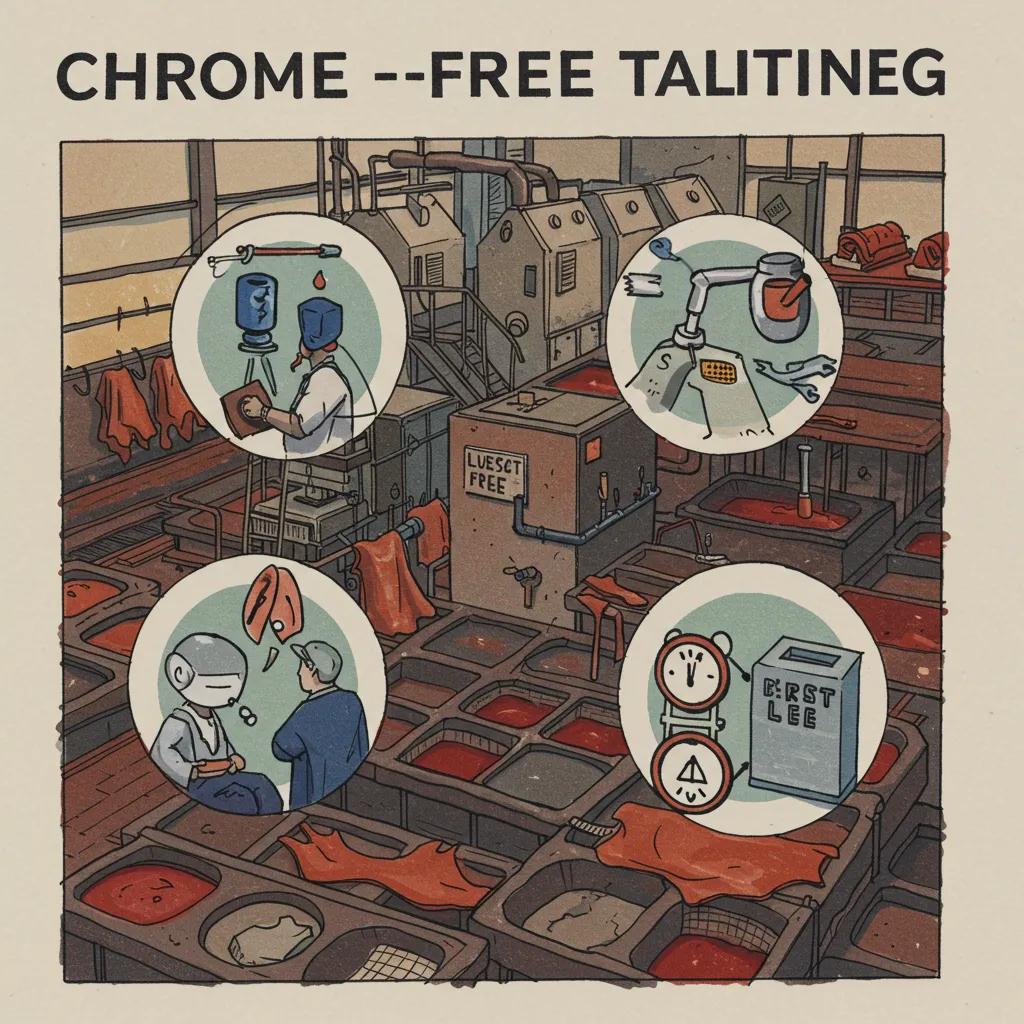
Chrome-free tanning produces leather without chromium(III) salts, using plant tannins, aldehyde systems, syntans, or other wet white chemistries to stabilize collagen. The key environmental gain is avoiding chromium in effluent—this lowers the risk of forming more toxic chromium species during treatment and removes a common source of regulatory pressure and remediation costs. When formulated correctly, chrome-free leathers can match many performance aspects of chrome-tanned leather, though they may need different processing and finishing steps. Knowing the trade-offs helps explain why many tanneries are switching to chrome-free systems.
How Does Chrome-Free Tanning Avoid Toxic Chromium Salts?
Chrome-free tanning substitutes chromium salts with alternatives—plant-based tannins, aldehydes, or synthetic tanning polymers (syntans)—and adapts pH, fixation, and dosing schedules to secure collagen bonds. That can mean longer soak times, staged additive additions, and revised dyeing or retannage sequences to reach the desired softness and fullness. Wastewater changes too—lower chromium but different organic loads—so treatment must be tuned. With careful process control, these substitutions yield leather with far less heavy-metal risk while preserving many desired physical properties.
What Are the Health and Environmental Advantages of Chrome-Free Leather?
Chrome-free leather lowers heavy-metal concentrations in tannery effluent, reducing soil and groundwater contamination risk and improving workplace safety by removing a major toxic exposure. These advantages ease compliance with stricter regulations and can cut long-term remediation liabilities for factories and neighboring communities. For consumers, chrome-free products reduce worries about residual metals in finished goods, increasing trust in apparel and accessories. Although the shift requires process changes, the lifecycle benefits often make the investment worthwhile.
What Is Wet White Tanning and How Does It Innovate Sustainable Leather Production?
Wet white tanning is a non-chrome method that stabilizes collagen before drying using aldehydes, zirconium, or synthetic tanning agents to produce pale, “wet white” leather ready for dyeing and finishing. It supports sustainability by producing low-heavy-metal outputs, delivering high dye receptivity, and giving flexibility in finishing—often reducing the need for harsh post-tanning chemicals. Wet white is well suited for products requiring bright, consistent dyeing and can pair with bio-based retanning agents to further cut environmental impact. Below we contrast wet white steps with traditional tanning workflows.
How Does the Wet White Tanning Process Differ from Traditional Methods?
Wet white replaces chromium fixation with aldehydes, synthetic polymers, or zirconium systems and shifts the processing sequence to stabilize collagen without metal cross-linking. Differences include earlier neutralization, altered retannage recipes, and finishing steps tuned to a pale substrate. Equipment stays largely the same, but chemical handling and effluent profiles differ. Chrome tanning typically offers fast fixation and high heat tolerance; wet white prioritizes dyeability and low-metal outputs—advantages for fashion leathers that need predictable, bright colors.
What Are the Environmental and Product Benefits of Wet White Leather?
Wet white leather reduces heavy-metal dependence, producing effluents with lower inorganic toxicity and easing regulatory pressure and treatment complexity. From a product perspective, wet white accepts dyes more uniformly, enabling vibrant, consistent colors—an asset for fashion and color-critical applications. Wet white leathers can also incorporate recycled or bio-based retannage components, improving circularity. Together, these environmental and aesthetic benefits make wet white an attractive sustainable option for manufacturers focused on color precision with lower metal risk.
The wet-bright development offers a chromium-free intermediate with exceptional dyeability.
Wet-Bright Tanning: A Chromium-Free Process for Vibrant Leather
This work presents a new tanning intermediate—wet-bright—that produces leather free of chromium, aldehydes, aldehyde precursors, and organic solvents. Because of its mineral character and bright whiteness, the intermediate offers excellent dyeability and very vivid colors. The system described (Tanfor TTM) is presented as safe for people and the environment and, compared with traditional methods, can provide both economic and environmental advantages.
How Does Pakistan Leather Ensure Quality and Sustainability in Its Leather Products?
Pakistan Leather (also known as Atlanta Enterprises) supplies premium leather garments and made-ups, combining skilled workmanship with the ability to create custom colors and hand-stitched details for wholesale and export. We work with sheep, goat, cow, and buffalo hides and offer product lines that include vegetable-tanned wallets, premium jackets, and bags made to client specifications. Our production blends traditional craft—hand stitching and careful finishing—with process controls that deliver consistent, durable goods. For buyers who want sustainable options, Pakistan Leather can scale custom orders while keeping quality standards high.
Which Sustainable Leather Products Does Pakistan Leather Offer?
Pakistan Leather produces a selection of sustainable leather goods built for longevity and style, choosing tanning methods that suit each product. Vegetable-tanned wallets showcase plant-based tannins and natural patina development. Jackets and bags are available in vegetable or chrome-free finishes depending on client needs, and we can deliver custom colors and hand-stitched details for bespoke requests. Available leathers—sheep, goat, cow, and buffalo—let buyers select grain, weight, and performance suited to the end use.
| Product | Tanning Method | Leather Type & Care |
|---|---|---|
| Vegetable-tanned Wallet | Vegetable tanning | Sheep/goat leather; avoid prolonged water exposure and condition with leather balm |
| High-end Jacket | Vegetable or chrome-free tanning | Cow leather; store dry, use gentle conditioners, and seek professional cleaning when needed |
| Leather Bag | Vegetable or chrome-free tanning | Buffalo/cow leather; protect from excessive humidity and apply routine conditioning |
How Does Pakistan Leather Maintain High Standards in Sustainable Manufacturing?
We keep standards through controlled factory workflows, an emphasis on skilled workmanship, and the flexibility to tailor processes—such as custom color development and hand-stitched finishing—across leather types. Our production follows established hide preparation, tanning, and finishing sequences that are adapted to chosen sustainable chemistries to ensure consistent performance for wallets, jackets, and bags. Our export and wholesale capabilities support larger orders without sacrificing detail, and clients can specify colors or stitching to match brand requirements. For purchasing or wholesale inquiries, contact options are provided directly by the manufacturer.
How Do Sustainable Leather Tanning Methods Compare to Traditional Chrome Tanning?
Comparing sustainable methods with traditional chrome tanning highlights differences in water use, chemical hazard, waste management, and processing time—factors that shape environmental footprint and downstream cost. Chrome tanning is fast and offers strong heat and shrink resistance, but it produces chromium-bearing effluent that needs strict treatment. Sustainable alternatives—vegetable, chrome-free syntans, and wet white systems—may require longer processing or different inputs but lower heavy-metal liabilities and improve end-of-life handling. The table below summarizes the key environmental trade-offs to aid procurement decisions.
| Tanning Method | Water & Energy Use | Chemical Toxicity | Waste Management | Time to Tan |
|---|---|---|---|---|
| Chrome Tanning | Moderate water; efficient timelines | High due to chromium salts | Complex, costly treatment | Short (days) |
| Vegetable Tanning | Potentially higher water cycles | Low heavy metals; higher organic load | Biodegradable organics; manageable with proper treatment | Long (days to weeks) |
| Wet White / Chrome-Free | Moderate water; variable energy | Low heavy metals; varied organic content | Easier heavy-metal control; tailored treatment required | Moderate (days) |
In practice, these differences mean:
- Vegetable and chrome-free methods cut heavy-metal risk and reduce long-term remediation costs compared with chrome tanning.
- Chrome tanning offers speed and some technical strengths (like heat stability), while sustainable methods focus on lower effluent toxicity and improved end-of-life options.
- Wet white systems give superior dyeability for fashion leathers; vegetable tanning excels at patina and long-term aesthetic aging.
These contrasts help brands and manufacturers make informed choices. For businesses prioritizing eco-benefits and product longevity, sourcing vegetable-tanned or chrome-free leather from experienced suppliers is a practical route.
As a commercial note, Pakistan Leather can fulfill wholesale and export orders for sustainable products and highlights durability and eco-benefits in bulk discussions. Interested wholesale buyers can contact the company to discuss volumes, custom colors, and workmanship.
What Are the Environmental Drawbacks of Traditional Chrome Tanning?
Traditional chrome tanning introduces chromium into wastewater, which—if not treated properly—can convert to more toxic forms and contaminate soil and groundwater. Tannery effluent also often carries sulfides and other process chemicals that demand specialized treatment systems and continuous monitoring, raising operating costs. Worker exposure to chromium and related reagents brings occupational health concerns and regulatory burdens. These impacts drive the industry toward low-metal alternatives where practical.
Why Are Sustainable Alternatives Superior for Consumers and the Planet?
Sustainable tanning methods are better for both consumers and the environment because they lower long-term contamination risk, improve worker safety, and produce leather that often lasts longer—encouraging fewer replacements. Consumers benefit from reduced metal exposure in finished goods, attractive patina with age, and products that align with circular-economy goals. For manufacturers, these methods can cut remediation liabilities and strengthen brand reputation under tightening regulations, offering a competitive edge for responsibly made leather goods.
- Sustainable tanning methods deliver clear ecological and health benefits that can justify modest process or cost adjustments.
- Export-focused manufacturers can adopt vegetable, chrome-free, or wet white methods to meet market demand for eco-friendly leather.
- Consumers who value longevity and lower toxic exposure will often find vegetable-tanned or chrome-free products offer superior lifetime value.
These practical trade-offs connect technical choices to buyer needs and product lifecycles.
Frequently Asked Questions
What are the main differences between vegetable tanning and chrome-free tanning?
Vegetable tanning uses natural plant tannins to stabilize leather, producing a durable material that develops a warm patina over time. Chrome-free tanning uses synthetic or non-chrome systems—like syntans or aldehydes—to achieve similar stabilization without chromium salts. Vegetable tanning tends to be slower and can use more water, while chrome-free approaches can be quicker and still reduce heavy-metal risk. Both reduce environmental impact compared with conventional chrome tanning, but they yield different handling and aesthetic results.
How can consumers identify high-quality sustainable leather products?
Look for transparency: clear information about the tanning method, traceable sourcing, and any third-party audits or certifications. Quality craftsmanship—neat stitching, solid finishes, and durable hardware—is also a reliable sign. For vegetable- or chrome-free items, check care instructions and ask the seller about wastewater and sourcing practices. Reputable brands will share materials and manufacturing details rather than hiding them.
What role do plant-based tannins play in sustainable leather production?
Plant-based tannins replace harmful chemicals like chromium salts and bind to collagen to create resilient, flexible leather. They reduce persistent toxicity in effluent, often come from renewable sources, and give leather a distinctive patina as it ages. Sourcing tannins responsibly further supports sustainability in production.
Are there any specific care instructions for sustainable leather products?
Yes. Vegetable-tanned leather should be kept away from prolonged water exposure and conditioned occasionally with a suitable leather balm. Chrome-free leather benefits from gentle cleaning and periodic conditioning to keep finishes stable. In all cases, avoid extreme humidity, direct heat, and prolonged sun exposure. Follow the manufacturer’s care guidelines for best results.
What are the environmental benefits of using wet white tanning?
Wet white tanning removes heavy metals from the tanning stage, producing effluent with lower inorganic toxicity and simplifying regulatory compliance. It also delivers excellent dye receptivity, enabling bright, consistent colors without aggressive post-tanning treatments. When combined with bio-based retannage options, wet white can further reduce environmental impact.
How does sustainable leather contribute to a circular economy?
Sustainable leather supports circularity by cutting harmful inputs, reducing waste, and producing longer-lasting goods. Methods like vegetable and chrome-free tanning make products safer to handle and easier to recycle or repurpose. Using recycled materials and bio-based components in production further improves the end-of-life options for leather goods, helping them stay in use longer or return safely to the system.
Conclusion
Choosing sustainable tanning methods improves environmental and workplace safety while delivering leather that stands the test of time. Vegetable tanning and chrome-free processes reduce toxic waste and support high-quality results that appeal to eco-conscious customers. When shopping for leather, prefer products with transparent sourcing and clear tanning information—these choices benefit the planet and give you better long-term value. Explore Pakistan Leather’s range of eco-friendly leather goods to find durable, responsibly made options for your wardrobe or wholesale needs.


